The Artist
Roland Lebrun
Ceramist · California & Oregon · Wood fire & atmospheric stoneware
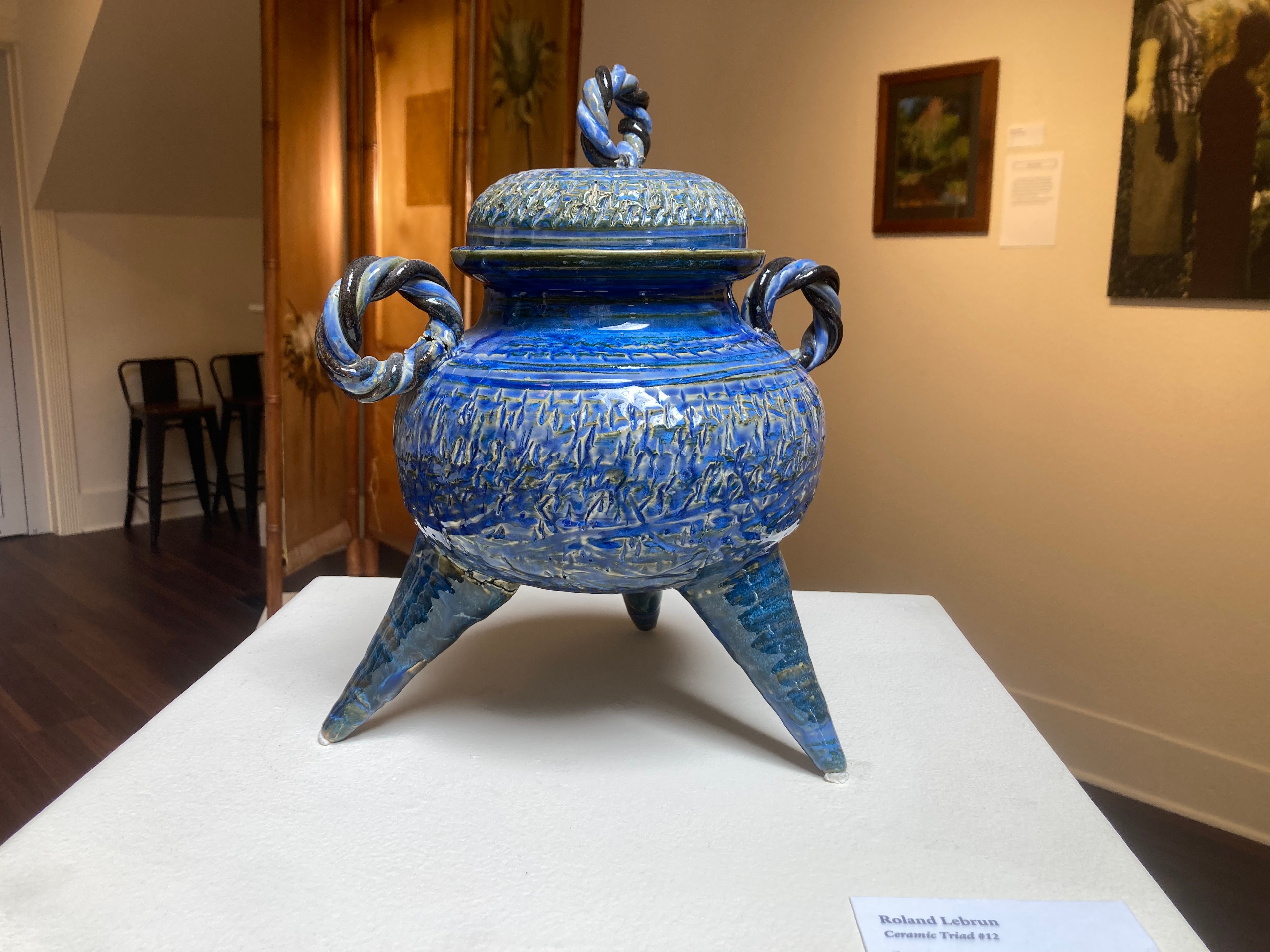
"Every piece carries the memory of fire — seven days of flame, smoke, and surrender."
Roland Lebrun has spent more than two decades making high-fire stoneware along the Pacific Coast — first in Northern California, now splitting his time between a coastal studio in California and a forest workshop in Oregon. His practice is rooted in progressive experimentation: a constant search for new forms, new surfaces, new conversations between clay and fire.
Roland does not simply use kilns — he builds them. His most significant firings happen in large-scale wood kilns constructed with the community, structures that take weeks to assemble and days to fire. This communal dimension is inseparable from the work itself. The kiln is not a machine. It is a gathering.
Each piece carries the ocean in it — the place where Pacific blue meets the warm ochre of coastal rock, where salt air meets ancient earth. The patterns that emerge from the fire are never designed. They are discovered. Each work is a singular intersection of intention and atmosphere, of the artist's hand and the kiln's will.
Philosophy
On making
Progressive experimentation
Roland's practice is defined by constant innovation — new forms, new clay bodies, new kiln configurations, new glaze chemistries. He does not repeat himself. Each series is a departure from the last. The studio is a laboratory, and the fire is the final test of every hypothesis.
The ocean meeting the coast
Every piece carries the poetry of the Pacific — the place where deep cobalt water meets warm ochre rock, where the cold of the open sea meets the warmth of the land. These are not decorative references. They are the emotional territory of the work. The colors, the textures, the weight of each vessel are drawn from that meeting place.
The collector relationship
Roland thinks carefully about where his work ends up. A piece that lives in a private collection — handled and considered over years — has a different life than a piece in a gallery case. He prefers the former. The Artist's Choice listings, where Roland selects the piece for the buyer after a period of reflection, are an extension of this: an attempt to match the energy of the work to the energy of the person who will live with it.
Process
From clay to fire
Clay body & preparation
Roland works with high-fire stoneware bodies sourced and blended for the specific thermal demands of atmospheric firing. Clay is wedged by hand, tested for consistency, and rested before use. The clay body is the foundation — its mineral content will determine how it responds to the kiln's atmosphere.
Forming & construction
Most pieces begin on the wheel, then are altered, carved, or assembled by hand over multiple sessions. Rope handles, braided elements, applied motifs, and textured surfaces are built up slowly, with drying time between each stage. Some forms are constructed entirely by hand — coiled, pinched, or slab-built.
Bisque & surface work
Pieces are bisque-fired to harden the clay while keeping it porous for glaze absorption. Surface work — carving, incising, slip application — continues after bisque. Glazes are mixed in the studio from raw materials and applied by dipping, trailing, layering, and wax-resist. A single piece may carry three or four glaze layers.
Building the kiln
Roland's most significant firings happen in large-scale wood kilns he builds with the community — structures of brick, mortar, and intention that can take weeks to construct. The kiln is not a tool borrowed from a catalogue. It is designed for the work, shaped by the site, and built by hands that understand what it will be asked to do.
The wood firing — seven days
Wood firing is a traditional method of atmospheric firing. The kiln is loaded, sealed, and fired continuously for up to seven days. Wood is fed around the clock — by Roland, by community members, by anyone willing to tend the fire through the night. The flame carries ash into the chamber. That ash melts onto the surfaces of the work, creating the naturally occurring tones and colors — the warm ambers, iron blacks, celadon whites, and deep blues — that no other firing method can produce.
Other kilns & methods
Depending on the desired result and artistic impression, Roland also fires in gas reduction kilns, soda kilns, and salt kilns. Each method produces its own atmospheric character. Gas reduction gives the deep cobalt blues and iron blacks. Soda and salt create flashing and surface movement. The choice of kiln is part of the artistic decision — not a technical convenience, but a creative one.
The reveal
After the fire ends, the kiln cools slowly — sometimes for days. When it is finally opened, the work emerges transformed. No two firings produce identical results. Pieces that entered the kiln together emerge with different surfaces, different depths of color, different lives. This is not a limitation. It is the point.
Selected Exhibitions
Exhibition history
A partial record. Many works have passed directly from the studio to private collections without gallery exhibition.
Provenance & Documentation
Every work is documented
Each piece that leaves the studio is accompanied by a signed certificate of authenticity, a record of the firing date and kiln conditions, and Roland's personal notes on the work. For major acquisitions, full provenance documentation is available on request.
Certificate of authenticity
Signed by Roland Lebrun, with work title, date, firing method, and materials
Firing record
Kiln log entry with temperature curve, firing duration, wood species used, and atmospheric notes
Artist's statement
A brief written note from Roland on the specific piece — its making, its character, what he sees in it
Acquire a work
The current collection is available through the shop. For commissions, private studio viewings, or works above $10,000, Roland welcomes direct contact.